Pondering Mastery – Is it just good teaching?

Michhayw's avatarmichhayw

After my Skiing holiday over the Christmas break, I have been pondering mastery (and also Learning Styles – but that may be another blog – just don’t tell @tombennett71 !)

Mastery techniques were first introduced and proposed by Bloom (1968), an American Educational Psychologist (who is also well known for his taxonomy) which focus on a learning model where students achieve a set learning objective or goal before they are taught the next skill.

The suggestion is that a teacher would set a threshold around the level of achievement which is usually measured by a test, with an eighty percent or above pass rate. If a student does not achieve this expected level, then they go back to revise and revisit the skills to tackle the test again and achieve the threshold before they can move to the next step.

This is a technique favoured by the French Ski School…

View original post 1,282 more words

Pondering Mastery – Is it just good teaching?

After my Skiing holiday over the Christmas break, I have been pondering mastery (and also Learning Styles – but that may be another blog – just don’t tell @tombennett71 !)

Mastery techniques were first introduced and proposed by Bloom (1968), an American Educational Psychologist (who is also well known for his taxonomy) which focus on a learning model where students achieve a set learning objective or goal before they are taught the next skill.

The suggestion is that a teacher would set a threshold around the level of achievement which is usually measured by a test, with an eighty percent or above pass rate. If a student does not achieve this expected level, then they go back to revise and revisit the skills to tackle the test again and achieve the threshold before they can move to the next step.

This is a technique favoured by the French Ski School. Above beginner ski level, when selecting a lesson, there are several options to choose, Stage 1, Stage 2, Stage 3 and Stage 4 (Expert). Each stage has to be achieved before moving to the next class. There is a test at the beginning of the lesson sequence, to establish that skiers are placed in the correct set. Thus, mastery in the French Ski school is set as,

Stage 1 – I can control my speed using basic turns with skidding on gentle slopes

Stage 2 – I finish my turn with parallel skis and I control my speed by skidding my skis

Stage 3 – I can link small and large radius parallel turns controlling my speed

Stage 4 (Expert) – I link small and large radius turns on all snow conditions and all terrain

The EEF Toolkit view on mastery is not dissimilar, focusing on clearly defined objectives, which have to be achieved before moving to the next stage.  The suggestion is that for mastery techniques to be successful, clear objectives are set and there is feedback available form a variety of sources.

The French Ski objectives, because they are one sentence long,  may appear easy to achieve, however going from basic turns to linking turns on all snow conditions and all terrain, would I consider to be on par with an Olympic standard. Therefore possibly unachievable to the majority of people who ski for one week a year on holiday.

We have adopted mastery into common educational usage, and taken on board advice from the EEF toolkit, especially around programmes such as the Mathematics Mastery Programme, but is it a technique? a teaching style? a strategy? or simply good teaching? and if relying on testing a strategy can it only work for a subject which can be taught in a linear way? In maths, our teaching cannot move on, for example to number bonds if our students cannot count and have not developed one to one correspondence. However in literacy our students will be able to read a level of narrative, such as a Great Expectations, but not reproduce this standard themselves, yet achieve good levels of writing competence, to enable them to reach national standards.

Comparatively for a physical activity, which requires a set of skills to be totally competent to safely get down a very steep mountain and which can depend on other variables, is a mastery programme which keeps a student at the same level for a number of years, the best approach?

To a non-skier, I could look like an expert as I can put on boots, clip into skis, use a lift (an art form in itself, and can depend on the lift – there are different types) and get down mountains without falling over, but my competence will depend on the snow conditions; fresh powder, and I’m the clichéd ‘King of the Mountain, but on icy, compacted snow, I adopt another cliché and could be described as ‘Bambi on ice’. On a blue run I could be an expert, but on a black run (the most difficult and complex runs) I could be at beginner or novice level.

I have lots of ski experience, yes,  and technically I’m not bad on some slopes, but experience a loss of skills when faced with something more challenging. The speed and what I feel is the lack of control, frightens me. No matter how many times I’m told to bend my knees and lean forward and all the other things I know I should do, when under pressure, they do not happen. I look down a slope, decide I can’t turn, and stop. I’m quite good at sliding, as this is my default position when I cannot make turns due to fear.

When I join ski school, how much does a ski instructor know about my skill levels and what I can do?  On a test run down a green run, I look Ok, and on a blue run I manage, I may make shorter turns but I can keep up with a group, stand up straight and look technically fine, but does anyone ask me about my confidence levels, which if asked is what I consider the barrier to my greater skiing achievement. No, is the answer, my achievement is judged by a visible observation.

Last year I wrote a blog, about my ski instructor – #SkiwithMatt and how he understood where my skiing mastery was and how he improved my confidence. The key to Matt’s success as a teacher was that he established what we wanted as a group, so that we could achieve, and key was that the group collectively wanted to enjoy themselves and not experience too much challenge.

Challenge can be good in some context, but sometimes as an adult I know how much challenge I would like. Matt liked to sing and encouraged us to do this when we found we were challenged, or frightened or scared (as a strategy, it worked for me) and as he had decided on the end goal, the tasks to get there reinforced this. It was always consistent (we sang everyday)!

This year, I have experienced first-hand how a teacher can get it wrong, working within the same mastery parameters. Firstly, I think, by not knowing his people and his group.  He started with giving everyone an easy test (ski skills tested on a very gentle slope – see above to why this is unrealistic) and then moving too quickly to a red run without explaining how and what. At no point did he ask his group what they wanted from the lessons.

If I’m going to tackle a red run, I like to prepare myself mentally, and think it through, also I like a choice about whether I want to do it or not. A surprise challenge for me does not work. Making assumptions based on a test and my mind set also doesn’t work – what do I want from ski school – a pleasant week skiing at my level. Overall this technique failed for me and made me doubt my ability, to such an extent I asked to move to another ski lesson with another instructor.

If I feel like this about something I have a choice about what I do, I don’t have to have ski lessons and I don’t have to go on another ski holiday if I don’t want to, but the learners in our classrooms, don’t have that same choice. When we work within what we consider mastery approaches are we thinking about our learners and what barriers and anxieties they may be bringing to the learning environment? Are we prepared for the learners who are going to take longer than their classmates to reach mastery? Do we have strategies to help learners who may never achieve the mastery level we have set for a class? What do we do about moving on, when not all of our class have not achieved mastery? How do we manage the learners who can achieve the level set, very easily? How do we keep these students motivated? Isn’t this good teaching?

I’m still pondering mastery, but to me I think it might be just a word to describe good teaching, as the test is an assessment technique to establish where learners are, and all good teachers, have ways of judging correctly where learners are and adjust their teaching accordingly.

I think mastery may restrict a teacher’s ability to adjust teaching to suit a group, as the parameters, like the French ski school, can be set that some will never achieve a mastery level. 

I am prepared to disagree and change my mind, if I am presented with a reasonable argument.

Can you persuade me to see if differently?


Voice. My version of #Nurture1617


What should my #Nurture1617 blog be about?

Last year I had been blogging about a month, when I discovered this new year tradition amongst Educationalists on Twitter. #Nurture 1617 seems to follow a rule of blogging about five achievements from the current year, which then leads to a contemplation of five things that are planned, possible intentions or achievable actions over the coming year.

In essence a blog which is an educational and work/life balance new year resolution

For #Nurture1516 I gave it a go. I did not publish it.

It was very simplistic. I wrote about maybe not eating so many orange matchmakers, undertaking some small scale SEND research within my leadership and Management capacity as SEN & Inclusion Manager, and writing a few more blogs.

I did revisit it a few times over the year to see if I was meeting my targets, and keeping my resolutions! Which mostly I was. Although perhaps don’t mention the matchmakers, as discovered they can be brought in certain discount shops for a pound!

So, I failed on the matchmaker eating, but I did undertake some SEND small scale research projects, which lead to being able to continue one piece of research around interventions, with a research grant acquired by The University of Wolverhampton.

I have written a few more blogs (12 this year, although not all of them have been published yet) and a piece for a #LearningwithoutLabels for Marc Rowland and several magazine articles on SEND Leadership and Management.

This year will my nurture blog look the same?

 It could to some extent.

I will still be eating matchmakers.

I am launching #ReserachSEND on February the 11th with the University of Wolverhampton.

 I’m aiming to write more blogs, using #weeklyblogchallenge17, to motivate me.

But #Nurture1617, is not going to be all about me, I am going to use it in a different capacity to consider the idea of #Learningwithoutlevels which Marc Rowland first proposed to me. I am going to think about the children who need us as Educationalists to put our differences, career progression and political opinions aside and concentrate on what the Educational Landscape looks like for them in 2017 and beyond.

We collectively need to look long and hard on what we do for the children who don’t have a voice through their parents or the school they currently attend, the children who face adversity every day and the ones who need us to advocate for them, because there may be no one else, for example,

·       The children who are missing from education,

·       The children who are looked after,

·       The children who are managing a bereavement,

·       The children who are school refusers,

·       The children who did not celebrate Christmas because their family could not afford it,

·       The children who have been permanently excluded from school, and an alternative placement cannot be found.

·       The children with SEND, who are not in the correct placement, or are undiagnosed, or have unmet needs because there is a lack of understanding of their needs

What will we be doing in 2017 to support these pupils and make things better for them?

I know as a starting point, we have newly formed Whole School SEND Consortium, which has brought groups together to improve outcomes for children with various needs, and we need this group and others like them to continue.  We need Head Teachers, who write about the challenges faced by children in their daily lives, such as Jarlath O’Brien, and other Educationalists like him and and we need parental advocates, who speak out on behalf of all parents such as Starlight McKenzie, Nancy Gedge and Tania Tirraoro.

I wish in 2017, that we do not see any more blogs, like the one I read earlier in the year, about why a child had to be excluded, when the excluder knew there was nowhere else for the child to go. We should be looking for solutions on behalf of these children, we know its not always easy, but we chose this job, the children we teach did not have a choice about whether we were their main educators.

My nurture 16/17 ends with a plea for us all to work together to change outcomes for children, for example,  

·       Let’s reduce the numbers of children who are excluded,

·       Let’s reduce the number of children who enter the youth offending system,

·       Let’s increase the amount of white working class students who enter University and stay there

·       Let’s provide an effective and collective voice for children with SEND,

And ultimately,

·       Let’s be responsible for the children we teach, and work with on a daily basis, to make sure that they receive the best education we can give them

·       Let’s not spend another year discussing what this looks like when children need us to focus on them.

·       Let’s as a profession, share what we know and work together to make sure that every child matters.

Are you joining me?

It really does only take one butterfly!

I have been thinking about butterflies this week.

Not single butterflies and not one particular type.

Not Red Admirals, Cabbage Whites or Painted Ladies.

Not the large examples of rare butterflies in the National History Museum, gathered by long forgotten Victorian Explorers, which were housed in rows of glass cases.

Not the 1970s sitcom written by Carla Lane and starring Wendy Craig and Nicholas Lyndhurst before he became ‘Rodney’.

But kaleidoscopes of butterflies, armies of caterpillars and the six most beautiful butterflies in the World – Blue Morpho, Ulysses, Zebra Swallowtail, Peacock, Goliath Birdwing and the curiously named Question mark.

And mostly butterflies which create change, not the widely held metaphor that butterflies are used to illustrate chaos theory by the single flap of a wing, but conversely the action of a butterfly as a catalyst for large scale change.

The thoughts started on Tuesday, in the Mercer’s Hall, in the City of London, with canapes and a conversation.

A networking session, where many people mingled and spoke about who they were and how far they had travelled.

It was the celebration of a longstanding school to school support system, developed by The London Leadership Strategy (LLS) to improve SEND leadership in schools and in doing so improve outcomes for pupils with Special Educational Needs & Disability (SEND).

Attendees had brought their SEND experience, compassion, advocacy and support; they came from schools; they came from charities and support groups; they were parents, teachers, headteachers, consultants and teacher-researchers, they were Dames, Sirs, OBEs, MBEs, CEOs, representatives from the DFE and CEOs from a range of SEND organisations.

All kinds of beautiful Butterflies, all waiting, for one butterfly to flap its wings.  To drive a change in the school system. To demonstrate how School to School support and system leadership can and has worked.

The first speaker of the evening was David Wood, Chair of LLS, followed shortly by the LLS SEND Lead & Director, David Bartram, and other influentual Educationalists such as Vijita Patel, Anita Kerwin Nye and Dr Tim Coulson, but It was David’s speech that referenced and reinforced the beauty and power of butterflies.

David expanded and elaborated on the theory that a group of butterflies in the Amazon, could create a climate change that could cause a tornado in the USA. Butterflies therefore can signify small actions.The small change, the butterfly effect, to which David referred, was an action a few years ago. In a Secondary School in West London, in which he worked, not small for the School, but at the time inconsequential to every other School in England.

The SEND Leaders programme began with the idea of sharing good SEND practice from within the school system, and championing good practice from that Secondary School in West London. This small step led to the now widely promoted – SEND review guide – A School led approach to improving provision for all. It does not stop with the publication of a guide though, it will continue to grow to a national SEND Leaders programme to benefit all through the Whole School SEND Consortium.

There will be more butterflies who will be able to become part of the Consortium, who will be able to share their experiences within their schools, clusters and MATs and who will be able to lead on the school to school model, who will be able to become coaches or be coaches.

It really does only take one butterfly.

Meanwhile on another wet and windy day, in Walsall at The University of Wolverhampton, this time a Saturday. Another group of butterflies are assembling, lead by Professor Dame Alison Peacock (who just so happens to share a name with one of the six most beautiful butterflies in the world!). The learning beyond levels ‘movement’ started with one tweet and although a tornado has not yet happened, it is likely that this movement is going to revolutionise how assessment is undertaken in the future.

Golden tickets holders went away  with some great messages frome the day, some of which reinforced and were repititious of the the principles behind the SEND Leaders programme, namely

  • We are part of a school led system
  • There is expertise within the School System
  • We can find ways to share expertise, experience and knowledge

As the sessions throughout the day were about learning without limits, there were other elements which are key if we are going to grow as a profession and develop our own solutions

  • We need to really understand what asssesment is and how to do it properly
  • We do not need colour coded spreadsheets to record the progress of pupils
  • We do not need to set target grades and if we make something a target, it puts a ceiling on it
  • We need to stop trying to recreate levels

It really does only take one butterfly.

Both the Whole School SEND Consortium and the Learning First model are moving away from a top down approach, where we are told and accept as a profession what to do.

Both groups recognise that there is not one way to do something, or one strategy in one school may not work in another and one leadership style may work in one school and not another.

Jointly maybe without realising it, they are both promoting the same message; a well informed profession which is based on effective practice, informs the successful strategies we should be using and both throughout their work are signposting, informing and guiding us to make the right choices for our schools.

It really does only take one butterfly, but there are room for more.

So if you are a beautiful butterfly with good practice to share…

Don’t keep it to yourself- Share it


Rumpelstiltskin – A Fairytale for Modern Times

Rumpelstiltskin

Once upon a time, there was a parent who had a daughter in year six.

One day the King sent for the parent, but when the parent stood before the King, she became frightened and blurted out the first thing that came into her head, “My daughter is so clever, she can pass whatever assessment is put in front of her, she doesn’t need to know the full syllabus and she even knows what a relative clause is.”

“Your daughter is indeed clever, if she can do as you say,” answered the King. “Let’s make all children across the land, prove they are as clever as her”

The next day, the King ordered all year six children to come to the Palace, were he lead them into a room filled only with desks, chairs, assessment papers and pens.

“Now get to work,” the King shouted. “Anyone who doesn’t pass this test, will have to stay in year six until they do”

As he said these words, the King left the room and locked the door. Most of the children, sat down on a chair and began to cry, they did not know what to do and they had no idea what a relative clause was.

After a few minutes, the door opened and a  magician  appeared, “why are all you children crying?” he asked. “We don’t know what to do,” wailed the children together, “we have to take this test or we will remain in year six for forever.”

“I do know what to do” said the magician, but I will need something in return. “You can take our mobile phones” said the children.

The magician said some unusual words that the children did not recognise, and magically their assessment papers were completed, with handwriting which was unique to every child.

“Now the King will think you are all as clever as each other,” said the magician as he disappeared in a cloud of smoke.

When the King returned later to see how the children were getting on, he could not believe that all the children had completed the assessment. He called the ‘Royal Marker’ who had to stay up all night making sure all the assessment papers were correct.

In the morning, the Royal Marker, informed the King that all the children had completed the assessment papers correctly. “They are indeed clever children,” thought the King, “I need to test them again, with some more difficult assessments, I wonder if they know what contracted forms, modal verbs and subordinate clauses are?”

When the King arrived to speak to the children, they thought they would be going home, but the King lead them to another room, where two assessment papers were waiting on individual desks for them.

The King once again, told the children they had to take the assessment and pass or they would stay in year six, and then he locked the door.

As had happened the day before, as soon as the King had gone, the magician who had helped the children appeared. “I can help you again,” he said, “but this time you must give me your gaming passwords” Again the children agreed and the magician said some unusual words and their assessment papers were completed.

Over several days the King kept making the assessment papers more difficult and  the children with the help of the magician managed to trick the King into thinking they could answer them all.

On the fifth day, the King promised that if the children could complete all ten assessment papers, this would be their passport to either an Oxbridge or a Russell Group University, as it showed that they were all clever. The children did not know what this meant, it was nearly as stange as the magician who was helping them pass the assessments, so they agreed.

And this is where my modern fairytale has to stop as it cannot keep up with the story of Rumpelstiltskin.

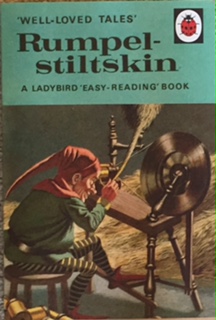
In the tale told in  Ladybird’s well loved tales, a miller’s daughter is asked to spin straw into gold, and when she is successful with the help of a character called Rumpelstiltskin, she has a happily ever and marries a King. The story does take another nasty turn, but the Queen triumphs in the end.

Unfortunately in this modern tale, there is no happily ever, our year six children have just taken a range of tests which if they do not ‘pass’ will have to repeat again at secondary school and there is no opportunity for triumph.

The reward is not bags of gold, or marrying a King, like in the traditional fairy tales, but resits  and taking more tests and assessments until children are ‘deemed clever enough’ to meet a national standard which appears to have been set with no consideration of even a simple distribution curve.

We do not know what the impact of this will be on a whole generation of children but I know many children at eleven and beyond, who do not know what the active voice is or what a subordinating conjunction, nor do they ever need to know.

I know for example, that at 16, my nephew would not be able to able to take the current year 6 assessments and score anything at all, he is still practising writing his name.

We have not got a Rumpelstiltskin to spin straw into gold for us, or a magician to help children pass unrealistic assessments so let’s stop this now, so we can change the ending to a happy one.


Tiramisu – Key Ingredients for NQTs

As an NQT, I learnt my craft, with a year two class in Stepney in the East End of London. There were a number of non readers, pupils who had newly arrived from Bangladesh with little or no spoken English and several pupils with Statements of SEN (now EHCP).

For those of you who know me personally, read my blogs or have listened to me present, you may have heard me say that applying to work in Tower Hamlets as a NQT, was one of the best decisions I ever made. The impact of this teaching experience on my career is unmeasurable and unquantifiable, and without doubt has enabled me to be the educationalist I am today.

I had completed my teaching training in Nottingham, and what a difference over a hundred miles makes. I moved to London to experience the ‘bright lights’ of city living, and having secured my teaching position, I had the opportunity to live in a Housing Association property in Bow, which wasn’t really what I had in mind, but it was cheap and there was a DLR station close by ( I would be giving my age away, if I said, it only ran on week days, and was replaced by a bus at the weekend)

When I took ownership of my classroom for the first time, it was like being asked to produce a Tiramisu in the technical challenge of the Bake off. I know what a Tiramisu looks like. I know what it tastes like. I have an idea of what some of the ingredients are. I could probably make some of the component parts.

For example, I know the measurements required for the construction of a  sponge cake, and it is all about the ratios of butter, sugar, flour and eggs, so could get so far, but then I would need to turn back to the recipe book for the oven setting and length of time it should be baked for. As this always takes time, energy and forward planning, and domestic tasks are not a strength of mine, if I want a sponge cake, I would most likely visit Waitrose, M&S or Tesco, and almost certainly if I wanted a Tiramisu I would buy one ( I have attempted a Tiramisu, once, and it was not that successful!)

As a NQT in a school, depending on the current training route undertaken, some of the key components for making a traditional Tiramisu may be missing, especially when supporting pupils who may be experiencing difficulties. As there is a language to cake baking, there is the creamed method, the folding method, the kneading method, there is a language for SEND; ASD, SALT, Multisensory teaching, EHCP etc.

During the technical challenge of the BakeOff, the bakers are given limited instructions and expected to understand caramelize, flute and fold. Consequently new teachers have their own technical challenge when they are given a class list and/or a provision map. Both of which could contain a range of terms, which could be unfamiliar if they have only been taught to make the equivalent of a Tiramisu and not the Jamie Oliver version with ‘bashed up coffee beans’ or one with a honeycomb topping.

For me, when assembling my ingredients for my first class, I had a superb mentor, who met with me regularly and helped me to plan for the different needs in my classroom, but also I needed to work closely with the school SENCO. She had the skills to be able to make the different versions of Tiramisu which were needed and she and was able to guide an NQT to master the original recipe. She was able to provide support on annual reviews, parental meetings, individual target setting, managing provision, supporting teaching assistants and general advice & guidance.

After my first year I knew I wanted to be like the SENCO. She was an inspiration and one of life’s angels. She was tireless and relentless in her support for pupils with SEND, as well as families living in challenging circumstances,  she could support families to find refuge, she could keep families together by finding respite opportunities,  and she would provide clothing for pupils who needed it, as well as  providing a breakfast club so pupils did not start the day hungry. She understood the need for ‘pupil premium’, well before it was a term used by the DFE.

Since my NQT year, SEND leadership has changed. There is no longer an expectation that one person alone in the school, knows everything about SEND, Inclusion, Safeguarding and Child Protection and that they should also know how to teach all children with a range of identified SEND difficulties.

For a current NQT, a package of support can be developed whereby a SENCO leads a programme to support an NQT to join the community of all teachers who are teachers of SEND. This would include talking to all teachers in the school about individual target setting, managing provision and teaching assistants, as well as visits a range of specialist centres of provision, such as Special Schools and PRUs.

I attended the The Key state of Education presentation last week, and a member of the audience said that of the NQTs joining the profession this year, 1/8 will go on to become Senior leaders in Schools. When I was an NQT, I did not anticipate that I would become a senior leader  who is able to lead SEND policy and practice, and mentor future senior leaders, but as my experiences  have enabled me to do so, I hope that I can continue to support all levels of the profession, by providing the correct ingredients for the task and if you ever want to share cake with me, let me know… I do like Tiramisu!

I remember…

I remember learning to read.

I remember whizzing through the first Peter and Jane books and reading about Pat the dog. I remember the frustration when I started to find it more tricky and it became a struggle.

I remember not being able to decode words. I would make them up to fit the text. For many years I thought the words ‘long vehicle’ on the back of a lorry were ‘long voyager’. My 6 year old logic was that  the lorry travelled a long way, ‘on a long voyage’.

I remember group reading, when I couldn’t keep up and when other children had to fill in the gaps for me. I remember one boy laughing at me because I couldn’t say binoculars and another because I couldn’t spell conversation.

I remember not being able to pronounce words and not being able to spell any of the words I was given to learn. I was given six spellings a week, when I was in year three on a Monday and tested on a Friday, I could never learn them all.

I remember I really wanted a fountain pen, and my Dad said I could have one if I got all my spellings correct for 5 weeks. It look me all year to achieve this, but only because the groups I got correct were regular patterns such as ‘ee’.

A year later, my brother with the same challenge did it in five weeks and didn’t really want a pen (can’t remember what he had – I’ll have to ask him)

Over the years I had avoided things such as modern foreign languages, reciting the alphabet and listening to any directions which involved hand gestures signalling left and right. I know if I cant’t spell a word or someone’s name I have to ask them to write it for me and I always have to ask for telephone numbers to be repeated in chunks.

I didn’t know I was dyslexic until I was 27.

By this time I had mastered reading and spelling and was embarking on a Masters in SEN and Educational Psychology and the first module was specific learning difficulties (dyslexia).

Mostly having a specific learning is an advantage, I know what I can and cannot do. I know I’m a big picture thinker and have some good ideas. I know I can find solutions and problem solve. I know I can drive things forward. I know not everyone can always see or understand my vision, but it usually makes sense and works out.

I have had to teach myself to be organised and love an excel spreadsheet for some of the work I do, but I would rather be drawing mind maps on large sheets of paper with a range of chunky felt tip pens. My notebooks are a mystery to most people (as some of my colleagues will testify) with arrows, lines and stars drawn everywhere, but they work for me.

Although in times of stress it may be more apparent that I have dyslexia and I make mistakes such as  texting the wrong person (I have done this twice to the same person, over the last couple of months – so apologies to them) or not expressing myself clearly enough, this is usually because lots is going on, and I do have to verbalise things many times. I think in pictures and I forget not everyone is visual or can see the same pictures as me. But I can remember conversations, even if others can’t and what people are wearing when I meet them (so beware!).

I recently worked with a school to produce a play which celebrated dyslexia and I was humbled by one of the pupils who as a teenager was proud to call himself dyslexic and recognise his strengths and weaknesses. For me I didn’t have this confidence or knowledge, when I was a teenager, nor did I know why everything was so difficult, but as an adult I have the empathy and understanding to support early diagnosis so other pupils can stand up and be proud.

Dyslexia is a gift and one I’m proud to say I have.

Rewriting Educational Narrative

The Lord pulled his cloak tighter around the bundle he was carrying in his arms. The snow was blowing in his eyes, but it was more important to keep the bundle he was carrying warm. He had been trudging through the Forest most of the night, and yet he hadn’t found a suitable place to leave his son. He wanted him to be found, but he didn’t want any one to know whose son he was.

Walking in the forest at night, was believed to be a foolish thing to do. There were rumours, of groups of outlaws who would attack, and take the belongings from anyone they met.  The Lord was thinking about these rumours, and how he may react if he met such a group, as he grew closer to a small cluster of tents. It was past midnight but he could still see some fires burning and hear the chatter of people tidying away. This would be the place to leave Robin.

John was digging over the fire to make sure it was out for the night, when he thought he could see a movement just behind one of the tents. Curious to see what it was, he stepped slowly forward. Whoever it was, had gone, and the footprints they made were already covered by the continuous snow fall.

Many years of hunting and tracking in the forest, had given John the skills to be able to sense a heartbeat, and this was what he could sense now. For an experienced tracker like John he was able to identify where the snow had been disturbed. He moved towards the sound, dropped onto his knees and began to move the snow with his hands. It only took him several seconds before he located the bundle and found himself looking at the face of a tiny baby.

John thought that the person who had left so quickly, must have done so for a reason, as the camp was at least five hours walk from the nearest house and a long way from any town or village. It was the reason his group had chosen the spot for the night. John did not hesitate, he knew that living in the forest with a band of outlaws was not a place for a baby but he decided that the outlaws would have to make room for one more. He carefully tucked the baby into his cloak and held him close while he returned to the tents…

Some of the elements of this story may sound familiar, could it be a plot from Game of Thrones, could it be the early life of Robin Hood, could it be neither? Was Robin left in the forest by his father? Was he found by a band of outlaws? Was this how Robin Hood began life as an outlaw who ‘robbed from the rich to give to the poor’?

Yes, I have rewritten the known narrative for the opening of the legend of Robin Hood. A story that has been passed down through the centuries. A myth. A legend. Its likely that there is some historical truth in the Robin Hood story, however we cannot separate the fact from the fiction, so could retell a new version and begin to change what we believe. It does not take long to change the myth. The story of Robin Hood as already been changed many times (including by Disney), which version is the correct one?

In Education, we do not have to look very far to find myths and legends, there are books on the subject, such as ‘Urban Myths about Learning & Education’ which examines many of these including, ‘93% of our communication is non verbal’, ‘boys are naturally better at mathematics than girls’ and ‘you can train your brain with brain gym’. We may all be thinking how could we have accepted such truth, but we do and we have.

We have a tradition in education to accept the headlines and then we rewrite the narrative. Its quickly becomes a truth, but unlike the Legend of Robin Hood, we use it to structure our teaching.  For example, there is much discussion around ‘learning styles’ which were for many years explicitly included into lesson planning as VAK (Visual, Auditory, Kinaesthetic) Where we doing the right thing? Where was the evidence which supported this practice?

I think it is time we adopted the philosophy behind the new member led College of Teaching, of taking back our profession and the narrative behind it. We can be and should be active within our own educational research. We should know we are delivering evidence based practice and where and what the evidence for this is.

We can do this, we can become the myth busters and by taking part in research can support professional development, bridge a research into practice gap and talk about our findings with others.

This week, the SEN & Inclusion team at Entrust, will be embarking on a SEND research project, with Praxis Education in which we hope we will be able to rewrite the narrative and challenge some of the myths that exist in Education. Maybe in 900 years people will be reading about us rather than Robin Hood.

I’m looking forward to it.


Filing in a Carrier Bag – Reflections on the National SENCO Award

Today we welcomed forty-four SENCOs to the seventh cohort of our National SENCO Award course. We work with The University of Birmingham to deliver this programme. The University is a Department of Education and National College for Teaching & Leadership approved provider for the National Award and has been running professional courses for SENCOs for fifteen years.

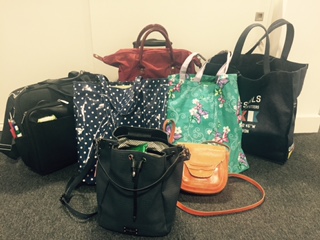
In 2010 when we first collaborated with The University of Birmingham, we used to show a film clip from Teachers TV to start discussion about the role of the SENCO.The clip showed a High School SENCO who was largely disorganised and struggled to prioritise tasks. She was shadowed by a ‘guru of priorities’ who gave her helpful tips throughout the day. On the National Award we used the clip to demonstrate organisation, and filled carrier bags with paperwork that could be the contents of a SENCOs ‘pigeon hole’ or their ‘in tray’. We asked our SENCOs to file the paperwork in order of priorities and encouraged them to ‘trash’ (word used in the clip) some of the items. The clip also promoted provision mapping as a new concept and an SEN Consultant visited her to help her set one up for her school.

Since 2010 nearly two hundred SENCOs have undertaken their National Award with us and a lot has changed since we welcomed our first cohort. The Teachers TV clip is no longer available (I’ve searched hosting sites such as you tube, and can’t find it), a version of a provision map is standard in every school and the carrier bags have either been replaced with a range of canvas bags acquired from The Education Show, or more likely  with a range of electronic devices and storage systems.

In 2010 I brought my first iPhone (iPhone 3s and I’m now on version 6) and the iPad had yet to be available, so most SENCOs had limited access to electronic resources and we would photocopy and/or scan journal articles, which could fill another set of bags over the course. Now we keep everything on the Canvas learning platform in the cloud and provide wi-fi for everyone to access them.

However the biggest changes to the Award since 2010 have been the recent SEND Reforms and the NCTL Learning Outcomes Framework. The National Award has always been a Masters level course (60 credits) which has required coursework to enable participants to demonstrate their knowledge and understanding but the role of the SENCO within school has evolved, and we now prefer to describe it as  SEN Leader. We would expect all SENCOs or would actively encourage them if they are not, to be a member of the Senior Leadership team. We want SENCOs to be  in a position to monitor the effectiveness of staff who work with pupils with SEND, to monitor the provision for pupils with SEND more effectively and to contribute more widely to  leadership and management across their school.

Over the ten days that we deliver the course  SEN leadership is integral  to the programme and we ask participants to reflect on their role back in school. The focus of each day still remains in general terms as it was in 2010,

Day 1- The Role of the SENCO and The SEN Code of Practice

Day 2 – Identification, Assessment & Intervention

Day 3 – Cognition & Learning

Day 4 – Communication & Interaction

Day 5 – Social, Emotional and Mental Health Needs

Day 6 – Managing & Developing Provision

Day 7 – Partnership & Participation

Day 8 – Physical & Sensory Needs

Day 9 – Leadership & Management

Day 10 – Presentations

At the end of the programme, participants give presentations on a SEN Leadership activity they have undertaken in School, which focuses on a range of themes from assessment & identification, monitoring, tracking & evaluation, improving teaching & learning, efficient use of resources, developing expertise, working with pupils & parents and improving outcomes.

I am very proud to be supporting SENCOs again this year to become great SEN Leaders and hope this cohort benefit as much from this course as our previous SENCOs have. I wish all our SENCOs the best and hope we have now fully moved on from the days of the carrier bag file. I’ll let you know.


Enigma – nothing is a puzzle if you know the answer

If you solved a Daily Telegraph cryptic crossword on the 13th January 1942, you could have played a crucial role in supporting the allies in the Second World War.

Individuals, the most famous of which was Alan Turing, were able to complete the Telegraph crossword in 12 minutes, and members of this group went on to become the Bletchley Code Breakers. The Code Breakers were known for ‘cracking the Enigma code’ or more accurately unravelled a German Army Administrative Key and the ‘red key’ used by Luftwaffe liaison officers coordinating air support for army units.

Every year we hold an Annual SENCO Conference to support SENCOs to develop SEN Strategic leadership in school and have become somewhat infamous for our titles, having named one Conference SENC007, and offering workshop sessions such  as ‘enter the Casino Royale to plan how to make effective use of the Pupil Premium’ and ‘Diamonds are forever – how to make the most effective us of teaching assistants’

It seemed fitting therefore that for our SENCO Conference in October 2015, we would adopt the title, ‘Enigma – Cracking the Code’, due to being a year into the SEND Reforms. However It was during the Summer that I began to think that maybe the theme should not really be about ‘Cracking a Code’ but solving a puzzle.

There was no code to crack; SENCOs already knew this code. Schools had adapted their policies in line with the new Code of Practice and followed guidelines on new Statutory responsibilities, such as the publication of a School Information Report on their website. The SEND Reform that was/would be bringing change, was around the SEN Assessment processes adopted locally by the Local Authority.

The new puzzle, and where I believe SENCOs need to focus in School is around every teacher being a teacher of SEN, and the strategic leadership role within improving teaching and learning, for example

Leadership

  • The SENCO is a member of the Senior Leadership Team
  • The SENCO is up to date with current policy and has disseminated this across the School
  • The SENCO closely monitors the effectiveness of Staff who work with pupils with SEND

Improving Teaching & Learning

  • Under the guidance of the SENCO, teachers plan pupil’s work, brief Support Staff accordingly and check how pupils are learning
  • Teaching is consistently good
  • Teaching and Support Staff break work into smaller steps so that pupils can see the progress they are making
  • Teachers mark pupil’s work regularly to inform lesson planning and provide constructive feedback they can act upon
  • Targets set are checked regularly to ensure they are appropriate for pupil’s needs 

For many SENCOs, these are not new puzzles. Many have been looking for the answers for some time. Like the Telegraph crossword which for most people is impossible to answer without the answers in front of them, many of the answers are available, its knowing where to look and in looking for the answers sharing with school staff so that the needs of pupils with SEND are effectively met.

All Teachers are Teachers of SEN, and many of then do not always realise it. A SENCO can help and support a classroom teacher to solve their own puzzles as well, by advising, mentoring and coaching.

During the Engima Conference we strived to support SENCOs to address these puzzles, David Bartram focused on Strategic leadership and spoke about School to School Support and Auditing current practice, Dr Garry Squires talked about the latest research on Dyslexia and staff from MoreHouse School in Surrey talked about meeting the needs of pupils with Speech and Language difficulties. We also held a range of workshops on meeting pupil’s individual needs, such as ‘building a picture’ which explored ways of gathering evidence which demonstrates support with pupils with Social, Emotional and Mental Health Needs.

SENCOs from the newly appointed to the more experienced, don’t just have to attend Conferences to support their development they can undertake training such as the National SENCO Award and work in clusters with other Schools to keep their knowledge up to date.

A SENCO does not need to have all the answers to all questions about SEND, but should be equipped to know where to find them. A SENCO may not be able to solve a crossword in twelve minutes and there maybe different solutions to the same puzzle, but nothing is a puzzle if you know the answer or at least know where to find it.

NB : If anyone knows this particular clue without looking it up  –  ‘official instruction not to forget the servants’ Let me know..